
Shop by goal
Butt Lifting & Hip Shaping Shapewear
volume, which works if you want a fuller, rounder shape than you currently have. Compression lift adds no volume — it pulls the surrounding tissue in and up so what's already there sits higher and reads rounder. Bloom's High-Waist Padded Butt Lifter Shorts use padding, with high-waist tummy compression above and mid-thigh smoothing below, so the shorts do three jobs at once. XS to XXL, $49.99. Whether padding shows under clothing comes down to two things: whether the pads are tapered rather than block-shaped, and whether you sized correctly — a too-small garment compresses around a pad and makes its outline obvious.
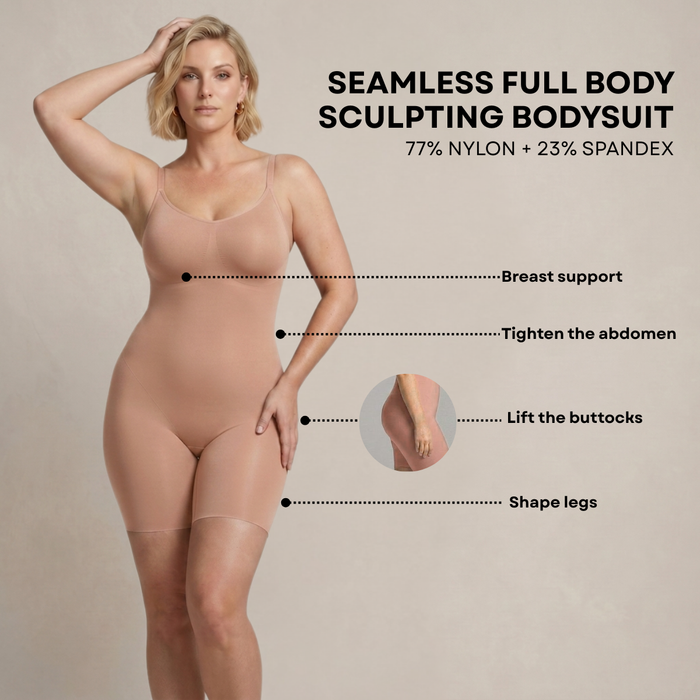

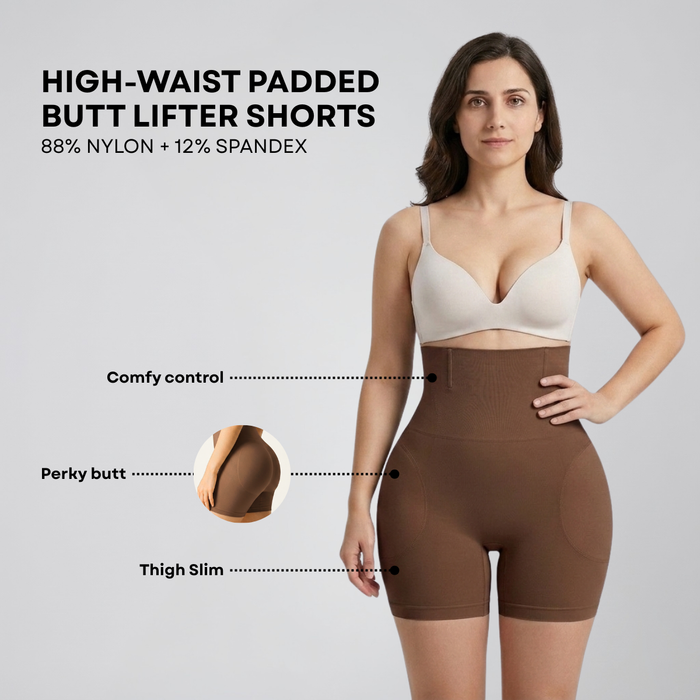

Padding or compression lift — which do you want?
| Padded | Compression lift | |
|---|---|---|
| What it does | Adds physical volume | Redistributes what's there, higher |
| Best if | Your seat is flatter than you'd like, or you want a noticeable change | You have volume already and want it lifted and rounder |
| Under fitted fabric | Fills out silk, satin and jersey convincingly | Smoother, but the change is subtler |
| Risk | Pad outline showing if wrongly sized or badly shaped | Less dramatic than people expect |
| Bloom option | High-Waist Padded Butt Lifter Shorts | Full Body Sculpting Bodysuit (compression, no pads) |
Neither is better. They solve different problems, and buying the wrong one is the most common reason people say butt shapewear "didn't do anything" — usually they bought compression lift when they wanted volume.
Butt pads and hip pads are not the same thing
This distinction is worth thirty seconds because it decides whether a garment will do what you want.
Butt pads sit at the seat, behind you. They add projection and roundness to the backside.
Hip pads sit on the lateral panel — the outer side of the upper thigh and hip. They fill the inward curve some people have between the hip bone and the thigh, and they change your silhouette when viewed from the front or the side rather than from behind.
A garment padded only at the seat will make your backside fuller and do essentially nothing for your side profile. If your goal is a smoother line from waist to thigh when you're seen from the front, you need side padding specifically. Bloom's Padded Butt Lifter Shorts add padding at the seat, for lift and roundness at the back.
Will the padding show?
The honest answer: it can, and there are three things that determine whether it does.
1 · Pad shape. Tapered pads — thickest through the middle and thinning toward the edges — blend into the body's own line. Block-shaped pads with a defined edge create a visible ridge under fitted fabric. This is the single biggest factor.
2 · Sizing. A too-small garment compresses tightly around the pad, which pushes the pad's outline forward and makes it obvious. Correct sizing lets the fabric sit smoothly over it. This is the opposite of what people assume — sizing down does not "hold the pad flatter."
3 · What you wear over it. Thick fabrics — denim, ponte, structured trousers — hide padding completely. Thin, fluid fabrics — silk, satin, light jersey — show far more. Under something very thin, a compression-lift style is often the safer choice than padding.
A practical test before an event: put it on, and sit down and stand up in front of a mirror in the outfit you're planning to wear. Movement reveals pad edges that a static mirror check doesn't.
Hip dips
Hip dips are the inward curve between the hip bone and the top of the thigh. They're determined by the shape of your pelvis and where the muscle attaches — skeletal structure, not body fat. That means they don't respond to exercise or weight change, and they're a normal anatomical variation rather than something that's gone wrong.
If you'd rather they were less visible under clothing, two things work:
- Side padding fills the depression directly and is the only method that physically adds volume there. Look for tapered pads on the lateral panel.
- Firm compression across the hip and upper thigh smooths the transition between hip and thigh without adding volume, which softens the line rather than removing it.
Everything else — including exercise programmes sold on the promise of eliminating them — is working against bone structure.
What to wear it under
Works well: fitted dresses in medium-weight fabric, jeans and structured trousers, skirts, ponte and jersey with some body to it.
Be careful with: silk, satin, very thin jersey and anything liquid-draping, where pad edges show most.
One useful pairing: high-waist trousers or a skirt with a firm waistband press the shorts flat and act as a second anchor at the waist, which reduces rolling.
The mid-thigh leg on the Bloom shorts also stops chafing under skirts and dresses, which is a genuine everyday reason to wear them that has nothing to do with shaping.
Sizing
Order to your hips. For this style especially — the whole garment is engineered around the hip and seat, so the hip measurement sets the size.
If you're between sizes, order the larger one. Sizing down doesn't improve the lift. It compresses the pad, making its outline more visible, and pushes tissue to the leg opening where it creates a ridge.
Check your thigh measurement too if your thighs are proportionally fuller than your hips. The leg opening is where this style most often fails, and it's the cause of shorts riding up.
On the leg hem: shorts that end at the widest part of your thigh have nothing narrower to grip and will migrate upward. The hem needs to sit below your widest point, where the leg tapers back in.
Full chart in the size guide → · How to stop shapewear rolling →
Not sure which style? Take the fit finder or email our fit team.